


Understanding Recycling Bales
What is a Recycling Bale?
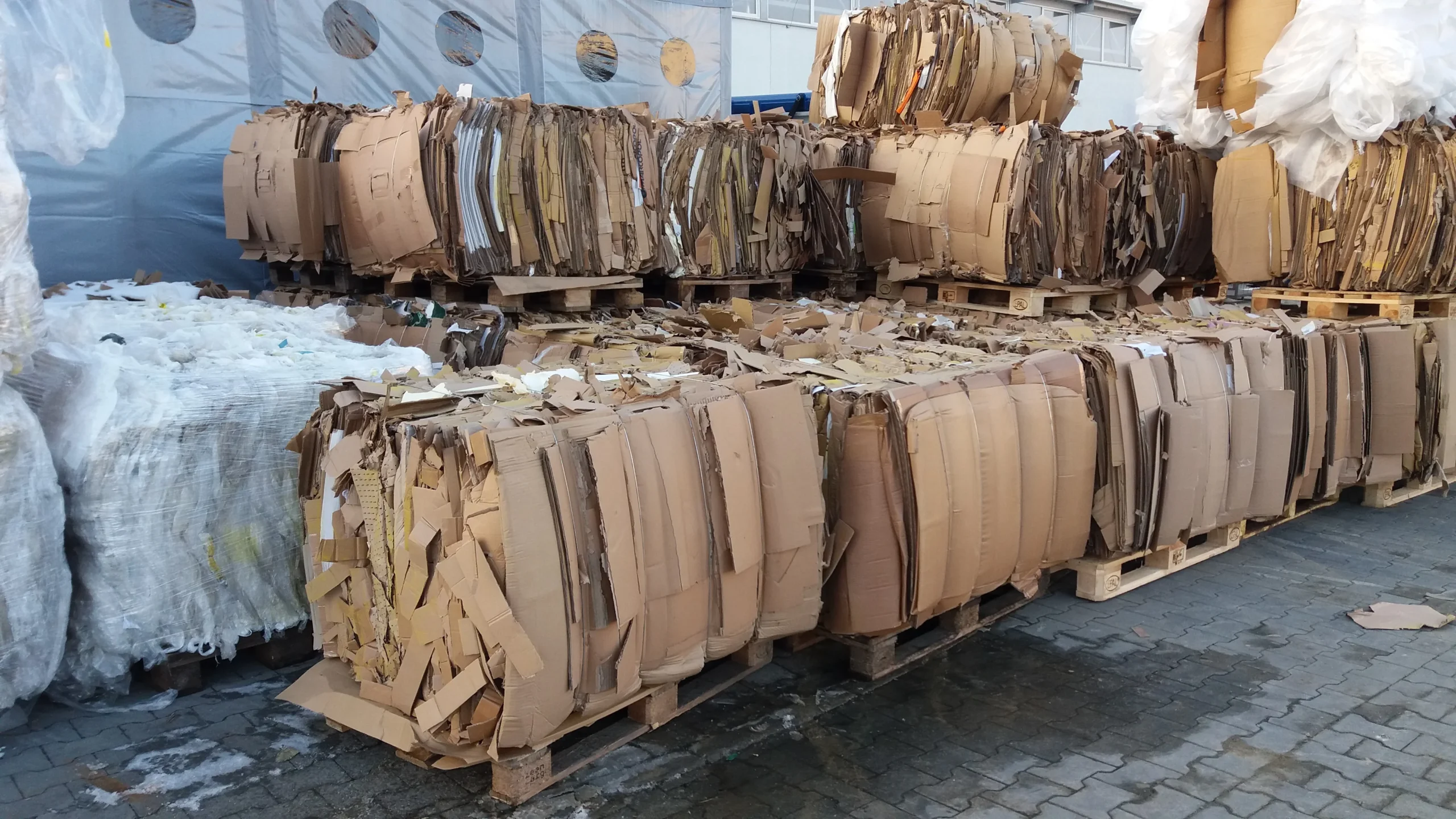
Recycling bales are compressed blocks of recyclable materials that serve as the standard commodity form for many recovered products. Unlike hay bales used in agriculture, recycling bales are dense cubes of materials such as old corrugated containerboard (OCC), various plastics, metals, and other recyclables that have been compressed under significant pressure. The bale is then secured using steel wire or flat strapping and is ready to be transported or stored.
The five most important factors when choosing a retail baler
1. How much cardboard does the store generate?
Waste volume is the first factor to consider.
A small store that fills a few roll cages each week has different requirements from a supermarket receiving multiple deliveries every day. If the baler is too small, employees may have to run frequent press cycles and produce many small bales. If it is too large, it may occupy valuable space without providing a meaningful operational benefit.
Measure waste volumes over a representative period rather than relying on a general estimate.
Record:
• the number of boxes or full roll cages generated each day
• how often cardboard containers are currently emptied (and the sizes of containers)
• how much space loose cardboard occupies
• how much time employees spend folding and moving boxes
• whether volumes increase during campaigns or seasonal peaks
• whether the store expects its waste volume to grow
The selected machine should be able to handle normal daily volumes without becoming a bottleneck. It should also have enough capacity for predictable peak periods.
2. How large are the cardboard boxes?
The filling opening is often as important as the press force.
A store may generate a moderate amount of cardboard but receive products in large transit boxes. If these boxes do not fit through the baler opening, employees will have to cut, fold or flatten them before loading.
That additional handling can reduce the time-saving benefit of the machine.
Measure the largest boxes that occur regularly and compare them with the feed opening of each model.
• The B4 has a feed opening of 30 × 18 inches.
• The B5 Wide has a feed opening of 39 × 21 inches.
• The B20 has a feed opening of 48 × 22 inches.
• The B6030 has a feed opening of 60 × 24 inches.
• The B7242 SD has a feed opening of 72 × 26 inches.
The B5 Wide is designed specifically for bulky material, even when the overall waste volume is relatively low. For higher waste volumes, the B6030 combines a 60 × 24-inch feed opening with the capacity to produce cardboard bales weighing approximately 800–1,200 lbs. For the largest retail and distribution operations, the B7242 SD offers a 72 × 26-inch feed opening and produces cardboard bales weighing approximately 1,550–1,850 lbs
3. How much space is available?
Measure more than the baler’s footprint.
The installation area must also provide enough room to:
• open the filling and lower doors
• stand safely in front of the machine
• tie the finished bale
• eject the bale
• position a trolley or pallet truck
• remove the bale from the area
• access the machine for cleaning and service
Also measure the delivery route. Check doors, corridors, elevators, loading bays and ceiling clearances before ordering the machine.
Ceiling height can be particularly important. Traditional vertical balers have their hydraulic cylinders above the chamber. X-Series models use internal cross cylinders, which can provide high press force while keeping the machine relatively low.
The X10 HD, for example, is approximately 75 inches high and delivers 22,000 lbs. of press force. The X25 HD is approximately 79 inches high and delivers 55,200 lbs. of press force.
Their internal cross-cylinder design makes these X-Series models relevant for backrooms with low ceilings, overhead utilities or shelving that limits the available height.
4. What bale weight can the store handle?
Bale weight affects storage, internal transport and collection.
Small bales are easier to move and may be suitable for stores without a forklift. However, the store will produce more individual bales and spend more time tying and handling them.
Heavy bales reduce the number of units that must be stored and collected, but they require suitable handling equipment.
Indicative cardboard bale weights include:
• B4: 85–130 lbs.
• B5 Wide: 175–245 lbs.
• X10 HD: 150–200 lbs.
• B20: 450–550 lbs.
• X25 HD: 500–650 lbs.
• B6030: 800–1,200 lbs.
• X6030 LP: 800–1,200 lbs.
• B7242 SD: 1,550–1,850 lbs.
The B4, B5 Wide and X10 HD may be suitable when smaller bales are preferred. B20 and X25 HD bales should be moved using a pallet jack, forklift or other suitable mechanical equipment. The B6030, X6030 LP and B7242 SD produce much larger, heavier bales for operations with appropriate handling equipment, storage space and loading facilities.
Before selecting a machine, ask your waste collector or recycler:
• which bale weights they prefer
• whether bales must be placed on pallets
• which tying material is accepted
• how many bales are required before collection
• whether different materials must be baled separately
The ideal bale weight should work for both the store and the company collecting the material.
5. How will the baler fit into the daily workflow?
A technically suitable machine can still be the wrong choice if employees find it difficult to use.
Consider where the cardboard is generated and how it currently moves through the store. The baler should ideally be positioned close to goods receiving, unpacking or another central waste point.
Evaluate:
• filling height
• door type
• cycle time
• noise level
• ease of loading
• bale-full indicator
• bale ejection
• access control
• distance from the unpacking area
• number of employees using the machine
Noise can also influence the choice when the baler is installed near the sales floor, offices or employee areas. The models in this comparison have stated operating noise levels of approximately 59–70 dB. The X25 HD and X6030 LP are among the quietest at 59–60 dB, while the B4, X10 HD, B20, B6030 and B7242 SD operate at approximately 60–65 dB. The B5 Wide has a stated noise level of 65–70 dB
The best machine is usually the one that employees can load as part of their normal workflow rather than treating waste handling as a separate task.
Anatomy of a Recycling Bale
A properly formed recycling bale has several key characteristics:
- Shape: Cubic form created through compression
- Binding: Secured with 2-12 metal wires that prevent the bale from expanding or falling apart
- Density: Highly compressed to maximize material weight per cubic foot
- Uniformity: Consistent dimensions to facilitate stacking and transport
Bale Dimensions and Weights
Recycling bales come in various sizes depending on the baler used and the facility’s requirements. The dimensions typically range as follows:
- Weight: A Bramidan B4 makes bales as light as 50 lbs, where a B6030 can create bales as heavy as 1000 lbs. Larger machines like horizontal balers can create heavier bales.
- Standard American size: 60 × 30 × 48 inch bales are most commonly used. Different bale dimensions may be used depending on the application and limitations.
The weight of recycling bales varies dramatically based on both dimensions and material type. Bale weights can be as light as 50 lbs, and as heavy as 1900 lbs depending on the model.
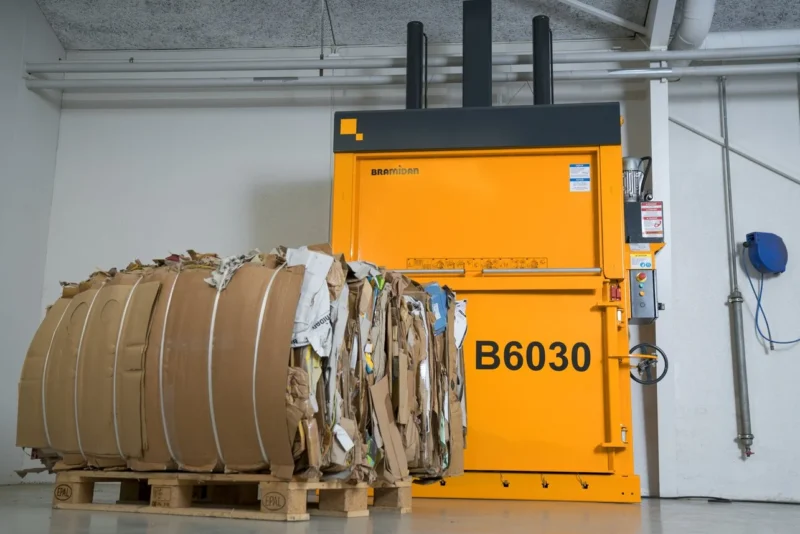
B6030 Vertical Baler
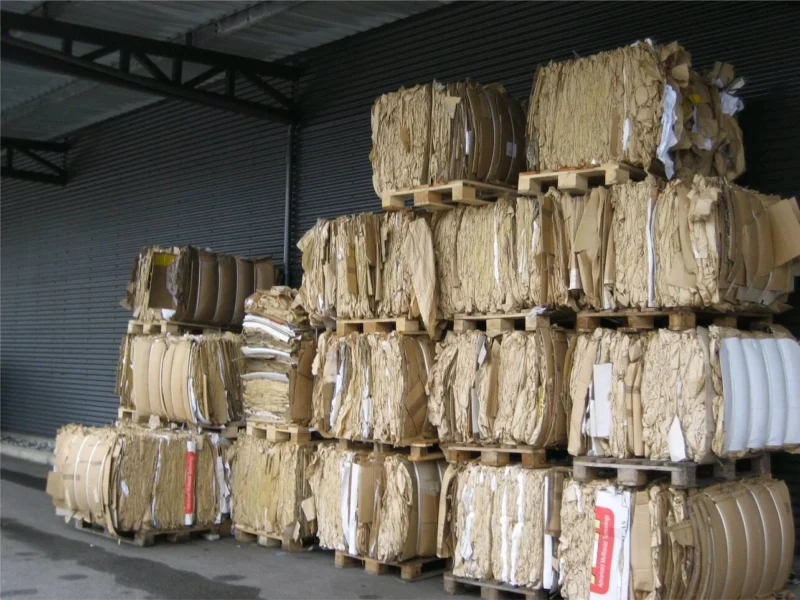
Stacked bales ready for transport
Commercial Value Considerations
For recycling bales to maintain commodity value in the marketplace, they must meet certain weight requirements. Typically, bales need to weigh over 850 pounds to have significant commercial value. Lighter bales often require rebaling to meet industry standards, which adds cost and reduces efficiency. The New York Department of Sanitation, for example, works with bales as small as 50 pounds, but these are outside the norm for commercial recycling operations.
Baling material like cardboard (OCC) with a vertical baler significantly increases its market value. Loose cardboard takes up more space, is costly to haul, and may be rejected by buyers. In contrast, dense, uniform bales are easier to transport and are preferred by recyclers, often commanding a higher price per ton. Market rates for OCC fluctuate, but businesses that consistently produce clean, well-baled cardboard can offset waste disposal costs. Mill-sized bales of OCC can range anywhere from $10-$70. Factors like demand, bale quality, and location can affect the value of your bales.
Depending on your region, some recyclers will have a preference on how bales are secured. This is generally dictated by how the bales are harvested. Baling wire is typically removed with a large magnet which is not possible with strapping.
Equipment Manufacturers
Companies like Bramidan produce balers designed to create bales of specific dimensions and weights. Bramidan manufactures 20+ models of vertical and horizontal balers which are built for various different volumes and applications. Their equipment specifications provide a useful reference for understanding the relationship between bale size and resulting weight, particularly for materials like cardboard.
Importance in the Recycling Supply Chain
Standardized baling is crucial to the economics of recycling. By compressing materials into uniform blocks, organizations can:
- Maximize storage capacity
- Reduce transportation costs
- Meet mill and processor specifications
- Facilitate accurate weighing and trading of materials
- Streamline handling throughout the recovery process
The humble recycling bale, therefore, represents not just compressed waste materials, but the fundamental unit of commerce in the global recycling industry.
Questions? Contact Us Today