


Compactor – efficient handling of large amounts of waste

Compactor – efficient compaction of large amounts of waste
In this article, you will get a practical guide to compactors, where we go through how they work, what advantages they offer, and how to choose the right solution for your business.
You will also gain insight into the difference between stationary and self-contained compactors and when a compactor can be the best choice for your waste management.
Residual waste, plastic, cardboard, and other production waste quickly fill up regular containers and require more frequent emptying. A compactor reduces waste volume and optimizes both operations, economy, and logistics.
In this article, we cover:
- What is a compactor
- How a compactor works
- The difference between stationary and self-contained compactor
- Advantages and economy
- Compactor vs. baler
- When the solution makes sense
What is a compactor?
A compactor is a machine that compresses the waste directly into a container using hydraulic pressure.
The purpose is to reduce the volume of waste and thereby decrease the need for transport and emptying.
A compactor is typically used for the following types of waste:
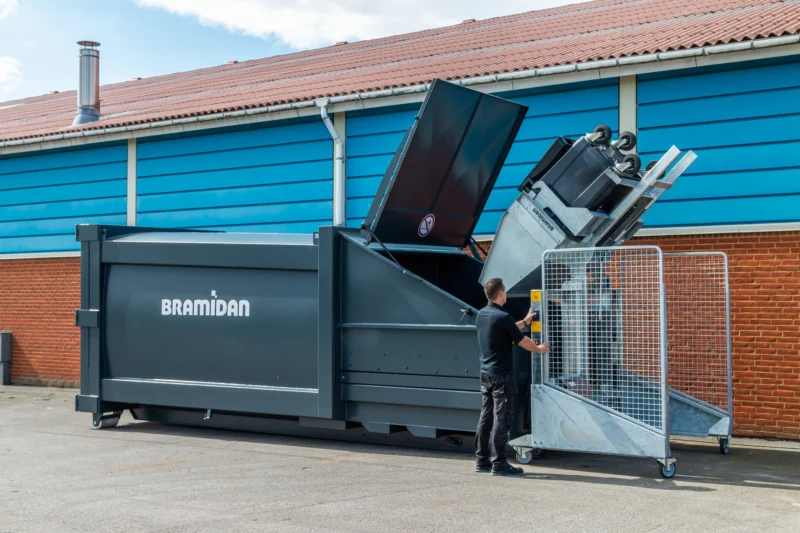
How does a compactor work?
Here is an explanation of the compactor process:
Waste is filled into the loading opening
Filling can occur in several ways. It can be filled manually – either from ground level or from a ramp.
You can also use mini containers to internally collect and transport the waste, and with the help of an integrated emptying system on the compactor – or an emptying system mounted on a ramp – empty these mini containers. Other filling options such as through a wall chute can also be an option.
The press cylinder is activated
When the waste is in the loading opening, the compactor’s hydraulic press cylinder is activated. The press plate moves forward and presses the material into the container.
The material is compressed directly in the container
The compactor compresses the waste and pushes it directly into the container. By compressing the material under high pressure, the volume of the waste is significantly reduced, providing a more efficient use of the container’s capacity.
The container is filled with tightly compressed waste
After several compression cycles, the container is gradually filled with tightly compressed waste.
Typically, a full notification is set up to notify when the compactor is 75-80% full and emptying of the compactor is required.
The result is a significant volume reduction – often up to 75%.
See a compactor in operation right here
Stationary or self-contained compactor?
It could be the amount of waste, space conditions, but perhaps especially local production needs and set-up that ultimately determine what the right solution is.

Stationary compactor
Advantages of a stationary compactor
Ideal for large, continuous waste volumes
A stationary compactor is particularly suitable for companies with large and continuous waste volumes, where the need for internal/manual handling of the waste is desired to be minimized.
Higher compaction force
A stationary compactor – depending on the model – typically has a higher press force than the mobile one, making it suitable for heavier and larger waste, such as production waste, cardboard, and large amounts of cardboard, residual waste, etc.
Flexible container size
With a stationary compactor, the container size can be adapted to the physical conditions at the installation site and to the need that may exist to optimize logistics. At the same time, the container – if an extra one has been acquired – can be changed quickly, so that only a short waiting time occurs in connection with the emptying of the container.
Efficient in industrial operation
A stationary compactor is developed for demanding business environments and operates stably in industrial operation, where efficient waste handling is an important part of the daily logistics.
Self-contained compactor (compactor container)
Advantages of a self-contained compactor
Minimal installation
A self-contained compactor requires only limited installation, as the compaction unit and container are combined in one solution.
This makes a self-contained compactor easy to implement without major changes to the company’s existing waste area.
Flexible placement
A self-contained compactor can be placed in different locations on the company’s premises depending on needs and space conditions. Only access to a power supply is required.
The flexible placement allows waste handling to be adapted to daily operations and logistics.
Versatile use
The self-contained compactor can be used for many different types of waste; such as residual waste, cardboard and paper, plastic, organic (wet) waste, and other fractions.
Space saving
The self-contained compactor is perfect where space is limited, such as behind stores, at warehouses, or on construction sites.
Robust and easy to maintain
The self-contained compactor is designed for outdoor use in all weather conditions and has relatively few wear parts to minimize maintenance.
Save on transportation costs
A filled self-contained compactor typically contains about 3 tons of cardboard and about 5-6 tons of residual waste – naturally depending on the waste. In a 20 m3 container with loosely folded cardboard, you would typically have 600-650 kg of cardboard. This means that with a self-contained compactor, you only need to empty once for every 5 emptyings of a regular 20 m3 container. In this way, transportation costs are saved, and depending on the setup, it can help reduce related CO2e emissions.
See our selection of self-contained compactors here
Benefits of a compactor
- Up to 75% volume reduction
- Internal savings on waste handling
- Reduces the need for container replacement and pickup
- Fewer transports
- Lower transportation costs
- Can contribute to lower CO2e emissions
- Better hygiene
- Structure and order around the waste area.
When should one choose a compactor?
By compressing the waste directly in the container, a compactor can significantly reduce the volume and thereby decrease the need for frequent pickups.
This can be an advantage for companies where transportation costs and logistics play a major role in waste management.
If the waste, on the other hand, consists of clean and sortable materials like cardboard or plastic, a baler can often be a more relevant solution. A baler compresses the material into dense bales that are easier to handle and can simultaneously have a higher recycling value.
Read about our balers here.
The price of a compactor depends on
- Type (stationary or self-contained)
- Compaction force
- Container size
- Installation
- Service agreement
Many companies find that the investment pays off through
- Lower internal handling costs
- Fewer pickups
- Lower transportation expenses
- Reduced waste fees
Intelligent waste management with BRA-IN
This allows for more precise planning and optimization of pickups, avoiding unnecessary transports.
At the same time, the system provides documentation for the efficiency of waste management and makes it easier to identify areas where operations can be improved.
Together, this creates a solid foundation for more data-driven and efficient waste handling.
Read more about BRA-IN for compactors here.

FAQ about compactors
What is a compactor?
A compactor is a hydraulic machine that compresses waste directly into a container to reduce the volume of waste. By pressing the waste together, the container is filled more efficiently, which can reduce the need for frequent pickups and make waste management more efficient in businesses with large amounts of waste.
How much does a compactor reduce waste?
A compactor can typically reduce waste volume by up to 80%, depending on the type of waste and the capacity of the compactor. By compressing waste directly into the container, space is utilized better, which means fewer emptyings and more efficient waste logistics.
What is the difference between a stationary and self-contained compactor?
A stationary compactor has a fixed press unit, while the container can be replaced separately during emptying. A self-contained compactor, on the other hand, combines the press unit and container into one complete unit, which is replaced as a whole when it is full.
Questions? Contact Us Today