


How to Choose the Right Vertical Baler for a Retail Store or Supermarket
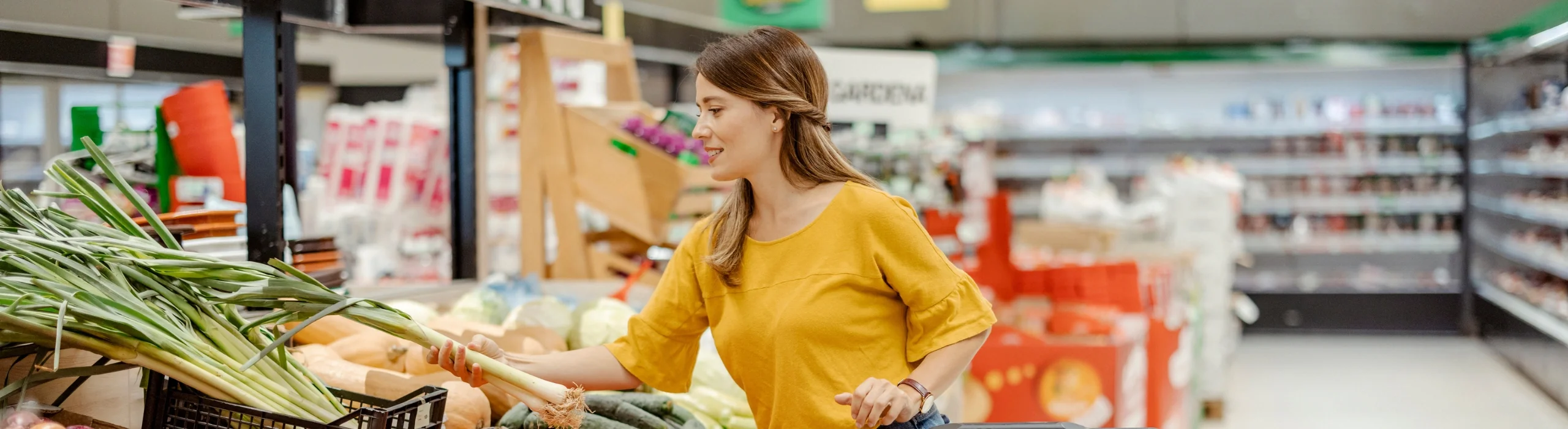
How to choose a vertical baler for a retail store or supermarket
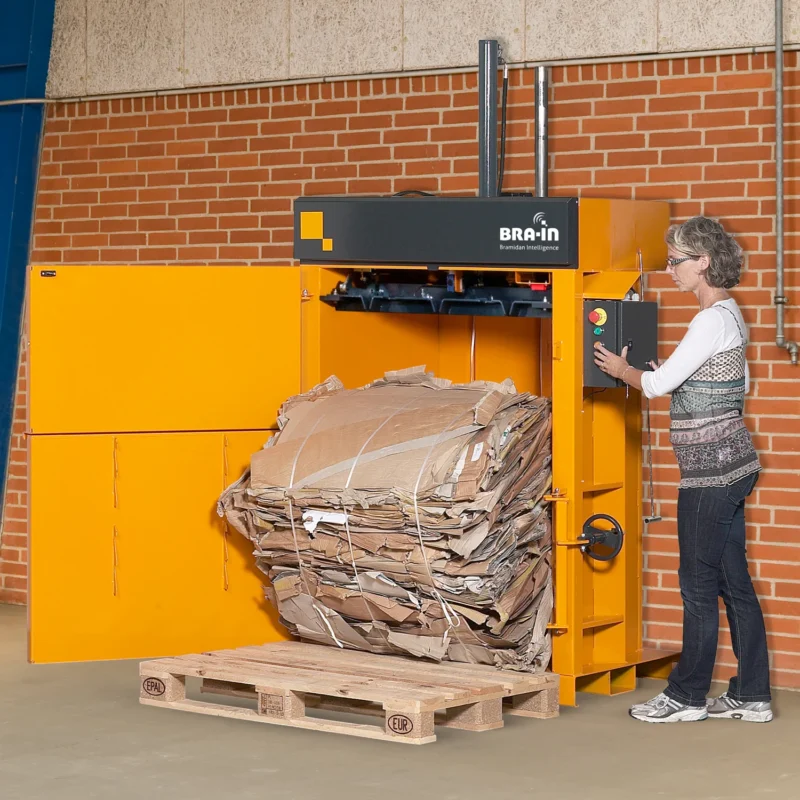
The right vertical baler for a retail store or supermarket depends primarily on five factors: the amount of cardboard generated, the size of the boxes, the available space, the preferred bale weight and the way employees handle waste during the working day.
A small shop with moderate cardboard volumes may need a compact single-phase baler. A busy supermarket receiving large deliveries may require a wider machine that produces heavier bales.
The aim is not simply to select the largest machine that fits. The baler should match the store’s actual waste volumes and make everyday waste handling easier without occupying unnecessary floor space.
This guide explains how to compare the most important factors and identify a suitable vertical baler for your retail operation.
Quick comparison: Which baler suits which retail environment?
For small retail stores, the B4 is a strong all-around choice. The B5 Wide is better suited for bulky cardboard boxes, while the X10 HD is relevant where low overall height or higher press force is a priority. Medium and large retail operations will typically require models such as the B20, X25 HD, B6030, X6030 LP or B7242 SD.
| Retail environment | Relevant US model | Main reason to consider it |
|---|---|---|
| Small store with limited space and moderate cardboard volumes | B4 | Compact 37 × 28 × 79-inch design and cardboard bales weighing approximately 85–130 lbs. |
| Small store receiving bulky cardboard boxes | B5 Wide | A 39 × 21-inch feed opening accommodates large boxes, while finished cardboard bales typically weigh 175–245 lbs. |
| Backroom with restricted ceiling height or a need for higher press force | X10 HD | The 75-inch overall height and 22,000 lbs. of press force provide strong compaction in a relatively small space. |
| Medium-sized supermarket with regular cardboard volumes | B20 | A 48 × 22-inch feed opening and 450–550 lb. cardboard bales provide efficient handling and fit standard US pallets. |
| Busy supermarket requiring high press force in a low-profile machine | X25 HD | Combines a 79-inch overall height with 55,200 lbs. of press force and cardboard bales weighing approximately 500–650 lbs. |
| Large supermarket, big-box store or distribution center | B6030 X6030 LP | Both models produce 60-inch, mill-size cardboard bales weighing approximately 800–1,200 lbs. The B6030 has a 60 × 24-inch feed opening, while the X6030 LP is designed for installations with ceilings below 8 feet. |
| High-volume distribution center or regional retail operation | B7242 SD | A 72 × 26-inch feed opening, semi-automatic sliding door and cardboard bales weighing approximately 1,550–1,850 lbs. make it suitable for significant volumes of recyclables. |
Why use a vertical baler in a retail store?
Cardboard can quickly take up valuable space in retail backrooms and goods-receiving areas. A vertical baler allows employees to compact it close to where it is generated, helping to:
- Free up floor and storage space
- Reduce the handling of loose cardboard
- Keep recyclable materials separated
- Create uniform bales that are easier to store and collect
- Improve backroom housekeeping and waste logistics
Bramidan vertical balers can reduce suitable waste volumes by up to 90%, depending on the material and machine selected. The aim is not only to produce a bale, but to improve the entire process from unpacking goods to collection.
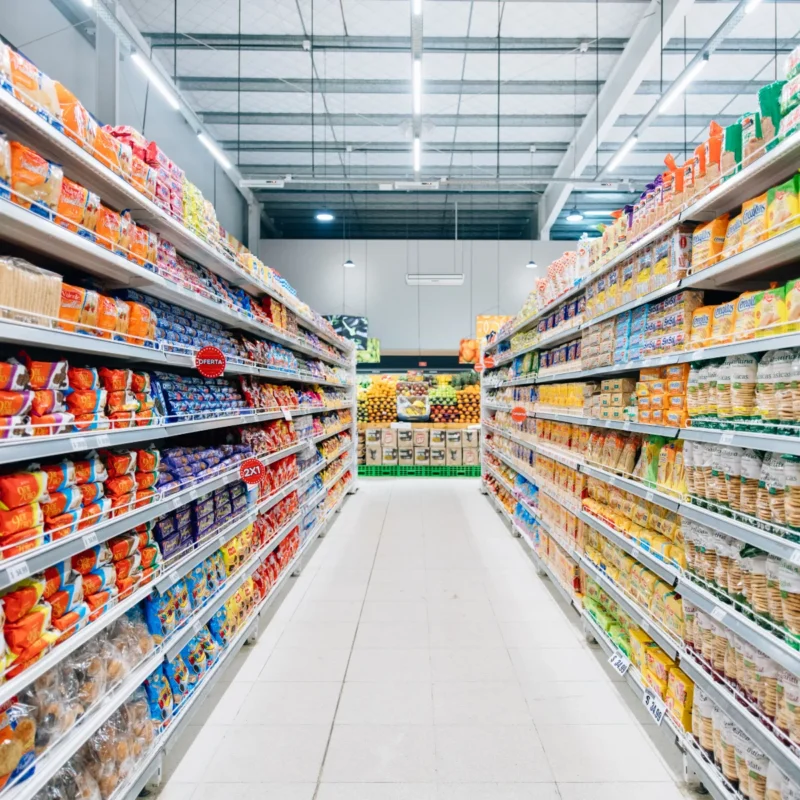
The five most important factors when choosing a retail baler
1. How much cardboard does the store generate?
Waste volume is the first factor to consider.
A small store that fills a few roll cages each week has different requirements from a supermarket receiving multiple deliveries every day. If the baler is too small, employees may have to run frequent press cycles and produce many small bales. If it is too large, it may occupy valuable space without providing a meaningful operational benefit.
Measure waste volumes over a representative period rather than relying on a general estimate.
Record:
• the number of boxes or full roll cages generated each day
• how often cardboard containers are currently emptied (and the sizes of containers)
• how much space loose cardboard occupies
• how much time employees spend folding and moving boxes
• whether volumes increase during campaigns or seasonal peaks
• whether the store expects its waste volume to grow
The selected machine should be able to handle normal daily volumes without becoming a bottleneck. It should also have enough capacity for predictable peak periods.
2. How large are the cardboard boxes?
The filling opening is often as important as the press force.
A store may generate a moderate amount of cardboard but receive products in large transit boxes. If these boxes do not fit through the baler opening, employees will have to cut, fold or flatten them before loading.
That additional handling can reduce the time-saving benefit of the machine.
Measure the largest boxes that occur regularly and compare them with the feed opening of each model.
• The B4 has a feed opening of 30 × 18 inches.
• The B5 Wide has a feed opening of 39 × 21 inches.
• The B20 has a feed opening of 48 × 22 inches.
• The B6030 has a feed opening of 60 × 24 inches.
• The B7242 SD has a feed opening of 72 × 26 inches.
The B5 Wide is designed specifically for bulky material, even when the overall waste volume is relatively low. For higher waste volumes, the B6030 combines a 60 × 24-inch feed opening with the capacity to produce cardboard bales weighing approximately 800–1,200 lbs. For the largest retail and distribution operations, the B7242 SD offers a 72 × 26-inch feed opening and produces cardboard bales weighing approximately 1,550–1,850 lbs
3. How much space is available?
Measure more than the baler’s footprint.
The installation area must also provide enough room to:
• open the filling and lower doors
• stand safely in front of the machine
• tie the finished bale
• eject the bale
• position a trolley or pallet truck
• remove the bale from the area
• access the machine for cleaning and service
Also measure the delivery route. Check doors, corridors, elevators, loading bays and ceiling clearances before ordering the machine.
Ceiling height can be particularly important. Traditional vertical balers have their hydraulic cylinders above the chamber. X-Series models use internal cross cylinders, which can provide high press force while keeping the machine relatively low.
The X10 HD, for example, is approximately 75 inches high and delivers 22,000 lbs. of press force. The X25 HD is approximately 79 inches high and delivers 55,200 lbs. of press force.
Their internal cross-cylinder design makes these X-Series models relevant for backrooms with low ceilings, overhead utilities or shelving that limits the available height.
4. What bale weight can the store handle?
Bale weight affects storage, internal transport and collection.
Small bales are easier to move and may be suitable for stores without a forklift. However, the store will produce more individual bales and spend more time tying and handling them.
Heavy bales reduce the number of units that must be stored and collected, but they require suitable handling equipment.
Indicative cardboard bale weights include:
• B4: 85–130 lbs.
• B5 Wide: 175–245 lbs.
• X10 HD: 150–200 lbs.
• B20: 450–550 lbs.
• X25 HD: 500–650 lbs.
• B6030: 800–1,200 lbs.
• X6030 LP: 800–1,200 lbs.
• B7242 SD: 1,550–1,850 lbs.
The B4, B5 Wide and X10 HD may be suitable when smaller bales are preferred. B20 and X25 HD bales should be moved using a pallet jack, forklift or other suitable mechanical equipment. The B6030, X6030 LP and B7242 SD produce much larger, heavier bales for operations with appropriate handling equipment, storage space and loading facilities.
Before selecting a machine, ask your waste collector or recycler:
• which bale weights they prefer
• whether bales must be placed on pallets
• which tying material is accepted
• how many bales are required before collection
• whether different materials must be baled separately
The ideal bale weight should work for both the store and the company collecting the material.
5. How will the baler fit into the daily workflow?
A technically suitable machine can still be the wrong choice if employees find it difficult to use.
Consider where the cardboard is generated and how it currently moves through the store. The baler should ideally be positioned close to goods receiving, unpacking or another central waste point.
Evaluate:
• filling height
• door type
• cycle time
• noise level
• ease of loading
• bale-full indicator
• bale ejection
• access control
• distance from the unpacking area
• number of employees using the machine
Noise can also influence the choice when the baler is installed near the sales floor, offices or employee areas. The models in this comparison have stated operating noise levels of approximately 59–70 dB. The X25 HD and X6030 LP are among the quietest at 59–60 dB, while the B4, X10 HD, B20, B6030 and B7242 SD operate at approximately 60–65 dB. The B5 Wide has a stated noise level of 65–70 dB
The best machine is usually the one that employees can load as part of their normal workflow rather than treating waste handling as a separate task.
A simple baler selection checklist
1. What materials will be compacted?
Cardboard, paper, and soft plastic may require different handling and should usually be baled separately.
2. How much material is generated?
Record normal volumes as well as seasonal peaks.
3. How large are the biggest boxes?
Compare their dimensions with the machine’s filling opening.
4. How much installation space is available? (and the route from unloading to installation)
Include working space, door movement, and bale ejection.
5. How will the finished bale be moved?
Smaller bales may be moved using a cart. Medium and large bales require a pallet jack or forklift.
6. Which power supply is available?
Compact models may use single-phase power, while larger models usually require three-phase power.
7. How often will the machine be used?
Frequent loading may make door type, filling height, and cycle time especially important.
8. What does the waste collector require?
Confirm preferred bale size, weight, tying method, and collection setup.
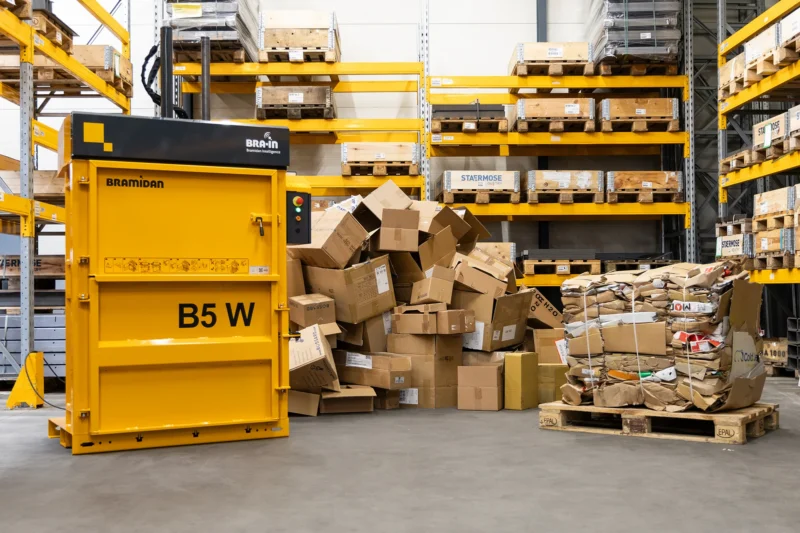
Which vertical baler is best for each type of retail operation?
Small retail store with limited space
The B4 is a suitable starting point for smaller retail stores with moderate amounts of cardboard.
It operates on a 110V single-phase power supply and produces cardboard bales weighing approximately 85–130 lbs. Its compact dimensions of 37 × 28 × 79 inches make it easier to install where floor space is limited.
Consider the B4 when:
- cardboard volumes are relatively low
- boxes fit through a 30 × 18-inch feed opening
- smaller bales are easier for the store to handle
- a standard 110V single-phase connection is preferred
The B4 has automatic bale ejection and a full-bale indicator light.
Small retail store with large cardboard boxes
The B5 Wide is designed for stores that generate relatively modest waste volumes but receive large or bulky boxes.
Its 39 × 21-inch feed opening reduces the need to cut or fold cardboard before loading. The machine operates on a 110V single-phase power supply and produces cardboard bales weighing approximately 175–245 lbs.
The B5 Wide may be a better choice than a narrower machine when box size creates more handling work than the overall volume of cardboard.
Backroom with a low ceiling
The X10 HD combines a relatively low overall height of 75 inches with 22,000 lbs. of press force.
It is relevant when:
- ceiling height is restricted
- the machine must fit below overhead utilities or shelving
- stronger compaction is required in a relatively small area
- a larger 31 × 24-inch feed opening is useful
- cardboard and other suitable recyclable materials may be processed
- a 110V single-phase connection is preferred
The X10 HD produces cardboard bales weighing approximately 150–200 lbs. and has a stated operating noise level of 62–64 dB.
Medium-sized supermarket
The B20 is designed for medium waste volumes and has a 48 × 22-inch feed opening for larger cardboard boxes.
It produces cardboard bales weighing approximately 450–550 lbs. The finished bales fit on a standard US pallet, making storage and internal transportation more predictable.
The B20 is particularly relevant when:
- cardboard is generated continuously
- a wide feed opening is required
- the store wants fewer, heavier bales
- a pallet jack or forklift is available
- 208V, 230V or 480V three-phase power is available
The X25 HD is an alternative when the supermarket requires greater press force or has limited ceiling height. It produces cardboard bales weighing approximately 500–650 lbs., delivers 55,200 lbs. of press force and has an overall height of approximately 79 inches.
Large supermarket, big-box store or distribution center
The B6030 is relevant for large cardboard volumes and oversized boxes.
Its feed opening measures 60 × 24 inches, and it produces mill-size cardboard bales weighing approximately 800–1,200 lbs. The machine uses a 208V, 230V or 480V three-phase power supply.
Consider the B6030 when:
- large cardboard boxes are handled every day
- high cardboard volumes are generated
- fewer, heavier bales are preferred
- a 60-inch-wide feed opening is required
- the facility has suitable forklift and loading equipment
- three-phase power is available
The B6030 can reduce preparation time because large boxes can often be loaded without extensive cutting or folding.
The X6030 LP is an alternative when the operation needs a full 60-inch bale but has limited ceiling height. It has a 60 × 21-inch feed opening, an installed height of approximately 93 inches and produces cardboard bales weighing approximately 800–1,200 lbs.
High-volume distribution center or regional retail operation
The B7242 SD is designed for operations that generate significant volumes of cardboard and other suitable recyclable materials.
It has a 72 × 26-inch feed opening, 110,000 lbs. of press force and produces cardboard bales weighing approximately 1,550–1,850 lbs.
Consider the B7242 SD when:
- very high cardboard volumes are generated
- a 72-inch-wide feed opening is required
- heavy, transport-efficient bales are preferred
- the facility has sufficient floor and ceiling space
- forklifts and suitable loading facilities are available
- 208V, 230V or 480V three-phase power is available
The B7242 SD is primarily relevant for large distribution centers, regional retail operations and other facilities with the handling equipment and storage capacity required for very heavy bales.
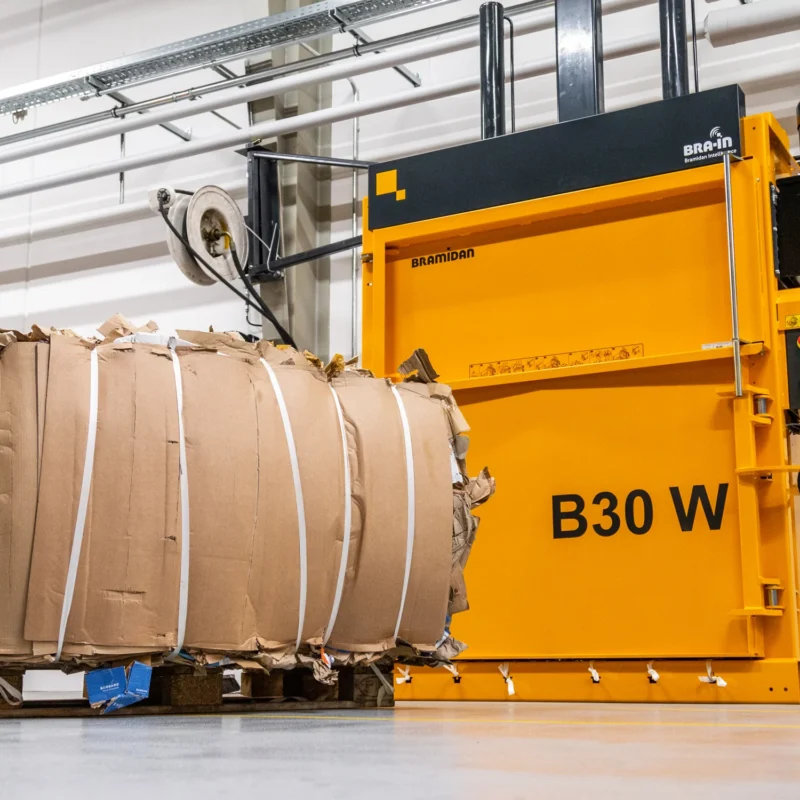
How the models in this guide were chosen
The final model should always be selected following an assessment of the store’s actual waste volumes and installation conditions.
Safety, training, and service should support the choice
For retail chains, access control and documented operator training may also be relevant. Bramidan Certify can help businesses structure and document operator training across locations.
Frequently asked questions
Which vertical baler is best for a small retail store?
The B4 is suitable for small cardboard volumes and limited floor space. The B5 Wide is a better starting point when the store handles bulky boxes, while the X10 HD is relevant when low overall height and stronger compaction are priorities.
Which vertical baler is best for a supermarket?
A medium-sized supermarket can often begin by comparing the B20 and X25 HD. The B20 has a 48 × 22-inch feed opening and produces cardboard bales weighing approximately 450–550 lbs. The X25 HD offers greater press force, a low overall height of approximately 79 inches and cardboard bales weighing approximately 500–650 lbs.
Larger supermarkets, big-box stores and distribution centers may require models such as the B6030, X6030 LP or B7242 SD.
How much space does a vertical baler require?
The required space includes the machine footprint plus room to open the doors, load material, tie and eject the bale and position a pallet jack or forklift.
Ceiling height and the complete delivery route must also be measured, including doorways, hallways, loading docks and overhead utilities.
Is the largest baler always the most efficient choice?
No. An oversized baler may occupy unnecessary space and produce bales that are difficult for the store to handle.
The most efficient choice is a machine that matches the actual waste volume, box size, available space and daily workflow.
Can the same baler compact cardboard and plastic?
Many Bramidan vertical balers can compact both cardboard and dry plastic film. However, the materials should normally be sorted and baled separately according to the requirements of the recycler or waste hauler.
Always confirm that the selected model is suitable for the material being processed.
Do vertical balers eject the bale automatically?
The Bramidan USA models compared in this guide have automatic bale ejection. After the finished bale has been tied, the operator activates the ejection system, which tips the bale out of the chamber.
A pallet jack, forklift or other suitable handling equipment may still be required to move the bale safely.
Should a retail store choose single-phase or three-phase power?
Compact models such as the B4, B5 Wide and X10 HD use a standard 110V single-phase power supply.
Larger models such as the B20, X25 HD, B6030, X6030 LP and B7242 SD require 208V, 230V or 480V three-phase power.
Always confirm the available electrical supply and local installation requirements before ordering.
Get help choosing the right vertical baler
The right baler should fit the waste stream, the facility and the employees’ daily workflow.
Before contacting a supplier, collect:
• estimated cardboard volume per day or week
• measurements of the largest boxes
• dimensions and photographs of the proposed installation location
• ceiling height and measurements of the delivery route
• available power supply
• preferred bale weight
• information about current waste collections
• details of available bale-handling equipment
Explore Bramidan USA’s vertical baler range or contact Bramidan USA for a recommendation based on your retail operation.
Questions? Contact Us Today